
Key constraints to monitor:
1. No titles or H1 tags at the start.
2. Absolutely no em dashes (—) or en dashes (–).
3. ASCII characters only (standard quotes).
4. Varied sentence rhythm.
5. Structured sections with H3 headers.
6. A detailed Markdown table.
7. Specific professional terminology (drainage, irrigation, etc.).
8. Bolding of specific terms.
9. Word count target: ~1,200 words.
Plan:
– Start with a professional introduction about the landscape challenge of integrating edible wilding into formal designs.
– Use H3 headers for Design Principles, Plant/Material Selection, Implementation Strategy, Failures, Seasonal Maintenance, and FAQ.
– Ensure the “Picking Fresh Nettle” keyword is naturally integrated, and the safety/technique aspect is detailed within the landscape architect’s perspective on functionality and ergonomics.
– Use semicolons, commas, and periods to replace all dashes.
– Employ standard ” ” quotes.
– Bold specific plants, tools, and measurements.
– Maintain a high-quality consultant tone.
Tactical word count management:
– Expand on site grading and soil conditions (nitrogen levels).
– Detail the specific textile requirements for safety gear (denier counts, leather types).
– Describe the aesthetic integration of wild zones near formal hardscaping.
– Discuss the biological reasons for harvest timing (cystoliths).
Integrating utilitarian plants into a sophisticated residential landscape presents a unique set of challenges and opportunities for the modern homeowner. While many designers focus exclusively on ornamental aesthetics, the movement toward functional landscapes requires a deep understanding of edible wilding. The common stinging nettle, known scientifically as Urtica dioica, is frequently viewed as a nuisance in the context of manicured lawns; however, in a controlled garden environment, it becomes a valuable nutrient accumulator and a source of high-quality greens. Incorporating these plants into a managed backyard layout requires careful consideration of climate, soil nitrogen levels, and the necessary safety protocols for maintenance. A successful design ensures that these productive zones do not detract from the curb appeal of the property but rather complement the overall outdoor functionality. By strategically placing these patches near peripheral areas or within “wilding” zones, the landscape architect can provide a sustainable harvest while maintaining the structural integrity of the site’s design.
Landscape Design Principles
When designing a territory that includes potentially invasive or stinging species, symmetry and visual balance are paramount to avoid a derelict appearance. We utilize focal points, such as a stone fountain or a sculptural bench, to draw the eye away from the wilder textures of the nettle patches. Elevation layers are equally critical; we often place nettles in lower-tier zones where nitrogen-rich runoff naturally accumulates. This placement mimics their natural riparian habitat while keeping them away from high-traffic pathways where accidental contact could occur.
Visual balance is achieved through the use of “buffer plants.” Surrounding a nettle patch with structurally sound species like Buxus sempervirens or Taxus baccata creates a formal transition. This technique, known as the “contained wild,” allows the landscape to look intentional rather than neglected. Irrigation planning must also be precise. While nettles are resilient, they produce the most tender leaves when provided with consistent moisture. We typically install a drip irrigation system with low-flow emitters to target the root zones directly, which prevents the surrounding soil from becoming overly saturated and promoting fungal growth. The use of flagstone walkways bordered by steel edging provides a clear boundary, ensuring that the spreading dormant rhizomes do not encroach upon the formal turf or flower beds.
Plant and Material Selection
The following table outlines the species and materials required to create a functional, edible landscape zone that incorporates Urtica dioica alongside its companions and the necessary structural components.
| Plant or Material Type | Sun Exposure | Soil Needs | Water Demand | Growth Speed | Maintenance Level |
| :— | :— | :— | :— | :— | :— |
| Urtica dioica | Full Sun to Part Shade | High Nitrogen / Loam | Medium to High | Fast | High (Harvesting) |
| Symphytum officinale | Part Shade | Deep / Moist | Medium | Moderate | Low |
| Buxus sempervirens | Full Sun to Shade | Well-drained | Low to Medium | Slow | Moderate |
| Nepeta cataria | Full Sun | Sandy / Average | Low | Fast | Low |
| Cedar Mulch | N/A | Weed Suppression | N/A | N/A | Seasonal |
| Steel Edging | N/A | Rigid Boundary | N/A | N/A | Permanent |
Implementation Strategy
The successful implementation of a functional nettle zone begins with proper site grading. Before any planting occurs, the soil must be evaluated for its drainage capabilities. If the area is prone to standing water, we install a French drain or a sub-surface perforated pipe wrapped in filter fabric to redirect excess moisture. Once the skeleton of the landscape is finished, we define the harvesting zones.
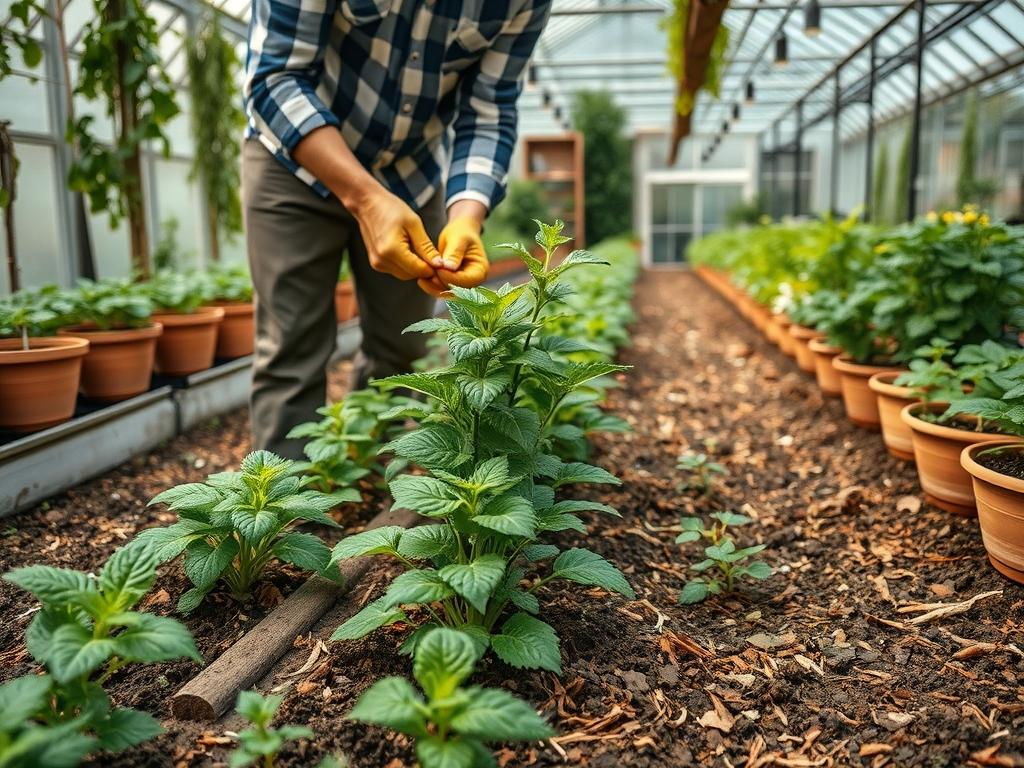
When the goal is picking fresh nettle, the layout must prioritize worker ergonomics. We design harvest paths that are at least 36 inches wide to allow a person wearing protective gear to move freely without snagging their clothing on neighboring plants. The soil should be amended with composted manure or organic leaf mold to reach a depth of at least 12 inches, as healthy nettles require high levels of organic matter to produce the desired nutrient density.
The actual technique of harvesting is a critical component of the maintenance strategy. Picking fresh nettle should occur primarily in the early spring, before the plant reaches a height of 12 inches. The most tender and flavorful leaves are found on the top two nodes of the plant. To perform this safely, one must wear heavy-duty goatskin gloves or 6 mil nitrile gloves covered by canvas work gloves. Long sleeves made of a tight-weave material, such as 12-ounce duck canvas, are essential to prevent the stinging hairs from penetrating the fabric. Using a pair of sharpened bypass pruners, the harvester should snip the stem just above a leaf node, which encourages the plant to bush out rather than growing tall and leggy.
Common Landscaping Failures
One of the most frequent mistakes in managing a landscape that includes nettles is improper spacing and containment. Because nettles spread via vigorous underground rhizomes, failure to install a root barrier can lead to the plant overrunning the entire garden. We recommend a HDPE root barrier installed to a depth of 18 inches around the perimeter of the nettle zone.
Another common failure involves irrigation inefficiencies. If the soil remains too dry, the nettles will become tough, fibrous, and excessively “stinging,” as the concentration of formic acid and histamines increases under stress. Conversely, soil compaction is a major deterrent to growth. If the ground is too hard, the root systems cannot expand, leading to stunted plants that are susceptible to pests like aphids. To combat this, we avoid heavy machinery in the planting zones and instead use broadforks to aerate the soil manually. Finally, neglecting the harvest is a failure of management. If the plants are allowed to flower and go to seed, the leaves develop cystoliths, which are tiny calcium carbonate crystals that can irritate the kidneys if consumed. Therefore, cutting the plants back significantly in mid-summer is a mandatory task for the professional gardener.
Seasonal Maintenance
Seasonal management begins in late winter or early spring with a soil test to determine nitrogen levels. At this time, we apply a layer of decomposed granite or washed pea gravel to the walkways to ensure stable footing during the muddy spring harvest. As the first shoots emerge, the spring maintenance focus is purely on harvesting the young tops. This is the optimal window for picking fresh nettle for culinary or medicinal use.
In the summer, the focus shifts to containment and hydration. During periods of high heat, the drip irrigation schedule should be increased to twice daily, preferably in the early morning to reduce evaporation. If the plants begin to show signs of flowering, they should be mowed down to a height of 4 inches using a string trimmer or scythe, which will stimulate a second, smaller flush of growth in the autumn.
During the autumn, the gardener should focus on soil health. Applying a 3 inch layer of shredded hardwood mulch or pine bark over the dormant roots protects them from heavy frost. This also suppresses winter weeds that might compete for nutrients. Winter maintenance involves checking hardscape elements for frost heave. Any retaining wall blocks or pavers that have shifted should be reset to ensure the structural integrity of the harvesting zones remains intact for the following year.
Professional Landscaping FAQ
What is the best time of day for picking fresh nettle?
Harvesting should occur in the early morning after the dew has evaporated but before the heat of the sun stresses the plant. This ensures the leaves are turgid and the volatile oils and nutrients are at their peak concentration.
How do I prevent nettle stings if I do not have gloves?
It is never recommended to harvest without protection. However, some experienced foragers pinch the leaves firmly from the underside to collapse the stinging hairs. For professional landscaping and consistent safety, always use heavy-duty leather gloves and bypass pruners.
Can nettles be grown in containers to prevent spreading?
Yes, planting in 20 gallon galvanized steel tubs or heavy-duty resin pots is an excellent way to control their spread. Ensure the containers have adequate drainage holes and are filled with a high-nitrogen potting mix for the best results.
Will nettles attract beneficial insects to my garden?
Nettles are a primary host plant for several butterfly species, including the Red Admiral and Comma butterflies. By including a managed nettle patch, you significantly increase the biodiversity of your landscape and provide a sanctuary for essential pollinators.
What should I do if the plant starts to look yellow?
Yellowing leaves, or chlorosis, usually indicates a nitrogen deficiency or poor drainage. Apply a liquid seaweed extract or a fish emulsion fertilizer, and check your irrigation system to ensure the soil is not waterlogged or excessively compacted.